Elite Chiller Transport

Refrigerated Truck Rental UAE for Temperature-Controlled Transport

Elite Chiller Transport provides refrigerated truck rental across the UAE for food, hospitality, retail and distribution businesses. We match the right truck to your cargo type, temperature requirement, load size, route and rental period.

Chilled, frozen or temperature-sensitive cargo — tell us what you need to move, where it’s going and for how long, and we’ll help you choose the right refrigerated truck.

HACCP Certified

Food-Safety System

ASATEEL Registered

Abu Dhabi Transport

Temperature
Monitored

Controlled Chilled
Transport

24/7 Support

Dispatch Assistance

Refrigerated Truck Rental for
Chilled, Frozen & Temperature-
Sensitive Cargo

The important word is not simply “truck.”
It is controlled.

It’s not just about moving cargo.
It’s about maintaining the right
temperature from start to finish.

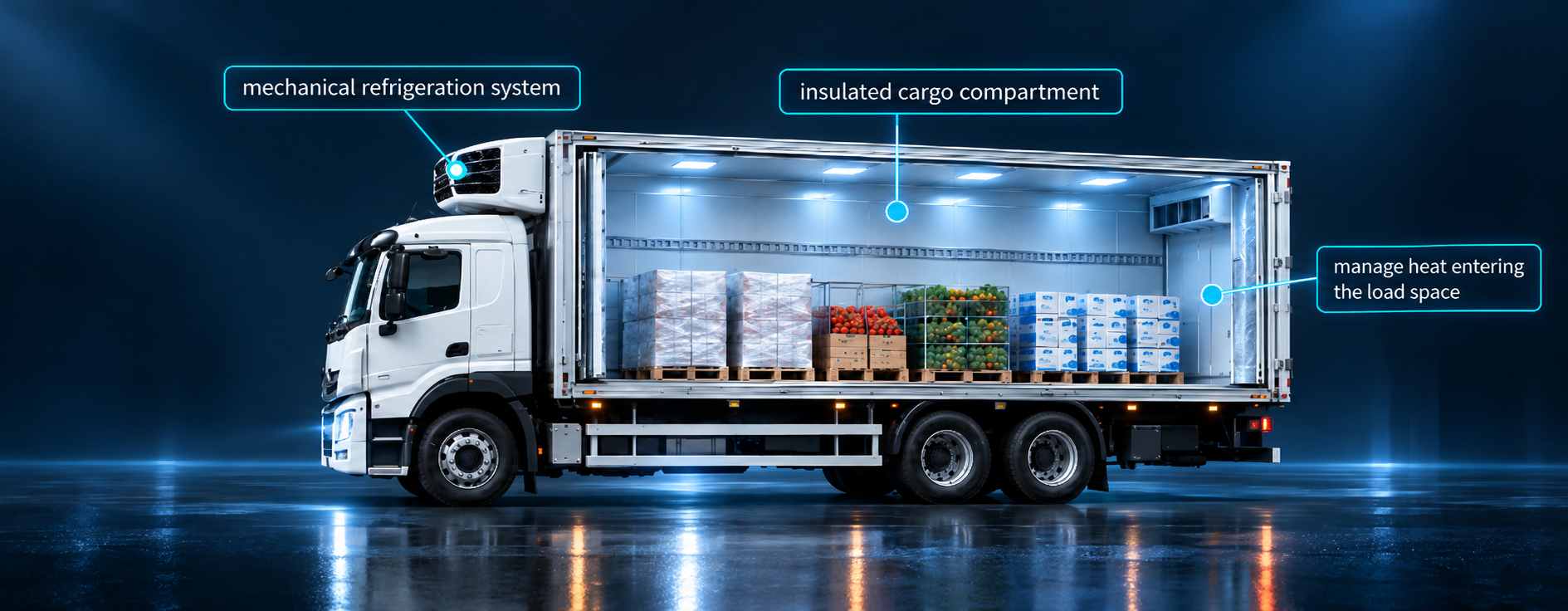
Refrigerated truck rental gives a business temporary access to a temperature-controlled commercial vehicle without purchasing and maintaining its own refrigerated fleet.
It helps you move chilled, frozen and other temperature-sensitive goods safely, reliably and in full control.

Temperature-controlled road transport includes different thermal conditions.

Chiller Truck

For Cooled Products
0°C to 8°C

Configured to maintain the conditions required for cooled products during transport.

Freezer Truck

For Frozen Goods
-18°C and below

Configured to maintain frozen cargo conditions throughout the journey.

Refrigerated Truck

For Broader
Controlled-Temperature
Distribution
Wide Temperature Range

The broader commercial vehicle category used for controlled-temperature transport.

The practical issue is cargo condition. A refrigerated vehicle should not be treated as a blast freezer for warm stock. In normal cold-chain work, products are brought to their required condition before loading and the transport equipment is used to maintain that condition during the journey.
Codex guidance similarly distinguishes transport equipment that maintains already chilled or frozen food from equipment intended to cool the product itself.
This distinction matters in the UAE because:
A truck may face repeated door openings, loading delays, traffic, multiple delivery points and high ambient heat.
repeated
door openings
loading delays
traffic
multiple
delivery points
high ambient heat
The correct rental therefore depends on more than whether the cargo is described as “cold.”

Which Refrigerated Truck Do You Need for

Your Cargo?

Choose the truck from the cargo requirement first, then choose the vehicle size. Starting with “I need a 3-ton truck” can produce the wrong booking. A more useful specification starts with the product, target temperature, load dimensions, weight, number of delivery stops and unloading method.

Key Questions Before Booking

These details help us match the right refrigerated truck to your cargo and ensure safe, compliant transport.
What are you transporting?

Dairy, frozen meat, seafood, produce, prepared food and other products can have different handling requirements.

Chilled or frozen?
The required thermal state determines whether chiller or freezer capability is needed.
What temperature must be maintained?
The set point needs to match the product requirement rather than a generic “cold” setting.
How much cargo
is there?
Weight, cubic volume and pallet dimensions affect the required vehicle class.
Pallets, cartons
or loose cargo?
Loading configuration affects usable cargo space and airflow.
How many stops?
Repeated door openings increase heat ingress and should be considered when planning the route.
Is a tail lift required?
Heavy pallets or equipment may require mechanical loading support.
Are temperature
records required?
Some customers need logged evidence rather than a dashboard temperature reading alone.
A “3-ton refrigerated truck” does not automatically mean 3,000 kg of usable payload.
Vehicle class, chassis specification, insulated body, refrigeration equipment, fuel, accessories and legal operating limits can affect the actual load that a specific vehicle can carry. If your shipment is close to the vehicle limit, send the actual cargo weight and dimensions before booking. Guessing from the truck name is avoidable risk.

Our Refrigerated Truck Fleet, Sizes & Specifications

The right fleet class depends on usable load capacity, cargo volume, refrigeration requirement and delivery environment.
Vehicle availability depends on route, cargo requirement and booking date.
3-Ton
Refrigerated Truck
Best for
Restaurant supply, food distribution, catering, medium commercial loads and city routes.
What to confirm before booking
7-Ton
Refrigerated Truck
Best for
Larger chilled or frozen distribution, warehouse transfers and higher-volume deliveries.
What to confirm before booking
10-Ton
Refrigerated Truck
Best for
Bulk commercial distribution and larger warehouse-to-customer movements.
What to confirm before booking

Additional Considerations

Truck tonnage is only one attribute. Also check the following for the allocated vehicle.
Truck specification
Check the temperature range, insulated cargo body, door configuration, refrigeration mode, load height, monitoring equipment and driver arrangement.
Pallet dimensions
For palletised freight, tell us both the number of pallets and their dimensions. Two loads with the same weight can require different vehicles when one occupies substantially more cubic space.
Multi-stop delivery
For multi-stop distribution, tell us that before dispatch. A point-to-point warehouse transfer and a route with a split door openings do not create the same thermal operating conditions.
NOT SURE WHICH REFRIGERATED TRUCK YOU NEED?
Send us your cargo type, temperature, weight or pallet count and route for assessment.
Expert Advice
Reliable Service
UAE Wide Coverage
We’ll help you identify the appropriate truck class.
P R I C I N G I N F O R M A T I O N

Refrigerated Truck Rental

Prices in the UAE

Refrigerated truck rental prices depend on the vehicle, refrigeration requirement, rental period, route and operating conditions; one generic AED-per-day figure cannot accurately price every job.
A quote for a local chilled-food run is structurally different from a freezer truck operating a longer route with a driver, several stops and waiting time.
Daily pricing generally suits temporary requirements. Weekly arrangements can fit short projects or seasonal demand. Monthly rental is normally evaluated differently because mileage, driver allocation, operating hours and fleet commitment become more important.
The quote should therefore identify what is included rather than showing only a headline rate.

Before Accepting a Price,

Check the Following:

These factors directly affect the rental cost and help you compare quotes correctly.
Vehicle
class
Rental
duration
Kilometre allowance
(where applicable)
Driver
arrangement
Fuel
arrangement
Waiting
time
Route
Refrigeration
requirement
Number
of stops
Additional loading
or equipment
requirements

The Cheapest Quote Is Not Always the Lowest-Cost Option

An undersized vehicle can require a second trip. An oversized vehicle can leave you paying for unused capacity. A vehicle that cannot support the required temperature is not an alternative at all.
GET AN ACCURATE QUOTATION
Send Us Your
Transport Details
For an accurate quotation, send the cargo type, required temperature, approximate weight or pallet count, pickup location, destination, date and rental duration.
CHOOSE THE RIGHT RENTAL TERM

Daily, Weekly or Monthly Refrigerated Truck Rental?

Refrigerated trucks can be hired around the duration of the transport requirement rather than forcing every customer into the same contract model.

Daily Rental

A daily refrigerated truck rental is appropriate when the requirement is temporary: an event, urgent delivery, replacement vehicle, unexpected increase in orders or one-off warehouse movement.

TEMPORARY REQUIREMENTS

Weekly Rental

A weekly arrangement can make more operational sense when deliveries continue across several days but do not justify a long fleet commitment.

SHORT PROJECTS
BEST FOR RECURRING REQUIREMENTS

Monthly Rental

A monthly refrigerated truck rental is usually relevant to distributors, food suppliers, hospitality operators and other businesses that need recurring temperature-controlled capacity.

RECURRING USE
DON’T CHOOSE FROM THE HEADLINE RATE ALONE

Compare the actual operating requirement.

Daily, weekly and monthly arrangements serve different operating requirements, so the most suitable option depends on how frequently and intensively the vehicle will be used.

Compare These Before Choosing a Rental Period

Expected Kilometres
Operating Days
Delivery Frequency
Driver Requirement
Dedicated Vehicle

For recurring routes, give us a typical weekly schedule. It produces a more useful assessment than requesting “monthly price” without the operating pattern.

What Temperature Does Your Cargo Need During Transport?

The correct transport temperature is the temperature required by the product—not a universal setting used for every refrigerated load.

“Refrigerated,” “chilled” and “frozen” describe different thermal requirements. Setting a truck colder than necessary can be as problematic for some products as running it too warm.

Cargo condition

Useful operating reference

Important qualification

Chilled food

Common food-safety frameworks use approximately ≤5°C for cold holding

Follow the product specification and applicable local requirement

Frozen food

−18°C is a widely used frozen-food reference

Product must already be appropriately frozen before transport

Vaccines / medicines

Many vaccines use +2°C to +8°C

This range does not apply to every pharmaceutical product

Other temperature-sensitive products

Product-specific

Follow manufacturer, shipper or validated transport requirements

Codex guidance emphasizes maintaining the required product conditions through storage and transport, while WHO notes that many vaccines use the traditional +2°C to +8°C cold chain. WHO also documents other validated temperature conditions for particular vaccines, which is why “all medicine goes at 2–8°C” is not a safe assumption.

Frozen is not simply “extra chilled.”
It is a different product state with a different control requirement.

When booking, give the required temperature as a number whenever possible.

For example:

+4°C
−18°C

That information is more useful than writing only “cold truck required.”

Chiller Truck vs Freezer Truck vs Reefer Truck: Which Do You Need?

Use a chiller truck for cargo that must remain cooled above freezing, a freezer truck for products that must remain frozen, and “reefer truck” as the broader refrigerated-vehicle term used across temperature-controlled transport.

Chiller Truck

Cooled above freezing.

A chiller truck is normally selected for products such as dairy, chilled beverages, fresh ingredients and other goods that need cooling without freezing.

Freezer Truck

Sub-zero transport.

A freezer truck serves frozen products such as frozen meat, seafood, ice cream and frozen foods where sub-zero conditions must be maintained.

Reefer Truck

Broad industry term.

A reefer truck is industry language for a refrigerated vehicle equipped with a refrigeration system.

1. Required temperature

e.g. +4°C, −18°C

2. Cargo type / product state

e.g. chilled, frozen, vaccines

3. Vehicle type

e.g. chiller, freezer or reefer truck

In practice, people sometimes use “reefer,” “refrigerated truck,” “chiller truck” and “freezer truck” interchangeably, but the operational requirement should still be defined by the actual temperature needed.

If you are unsure which one to request, send the product and required storage or transport temperature. That information is more useful than trying to choose the terminology yourself.

Refrigerated Truck Rental With a Driver or Specific Driver Requirements

Driver requirements should be confirmed before quotation because refrigerated transport involves both vehicle operation and refrigeration-system handling.

Driver-included booking

Let us handle the driving, so you can focus on your cargo.

A driver supplied for a temperature-controlled route needs to understand more than navigation. The job can involve checking the refrigeration controller, protecting the cargo compartment during stops, managing doors correctly, following delivery windows and reporting operational problems.

Self-drive refrigerated truck

Request self-drive availability at the beginning of the enquiry.

If you specifically require a self-drive refrigerated truck, state that at the beginning of the enquiry so availability, vehicle class, insurance, licensing and rental-policy requirements can be checked.

Do not assume every commercial refrigerated vehicle can be released without a driver.

For scheduled commercial distribution, a vehicle-with-driver arrangement can remove the need for the customer to organise an eligible commercial driver separately.

For driver-included bookings, provide:

Loading time

Destination

Expected waiting time

Number of stops

Route or delivery details

Choose the right vehicle and rental arrangement.

Tell us about your cargo, temperature and delivery plans, and we’ll help you find the best solution.

OUR TRANSPORT PROCESS

What We Confirm for
Temperature-Controlled Transport

Temperature control starts before the truck moves.

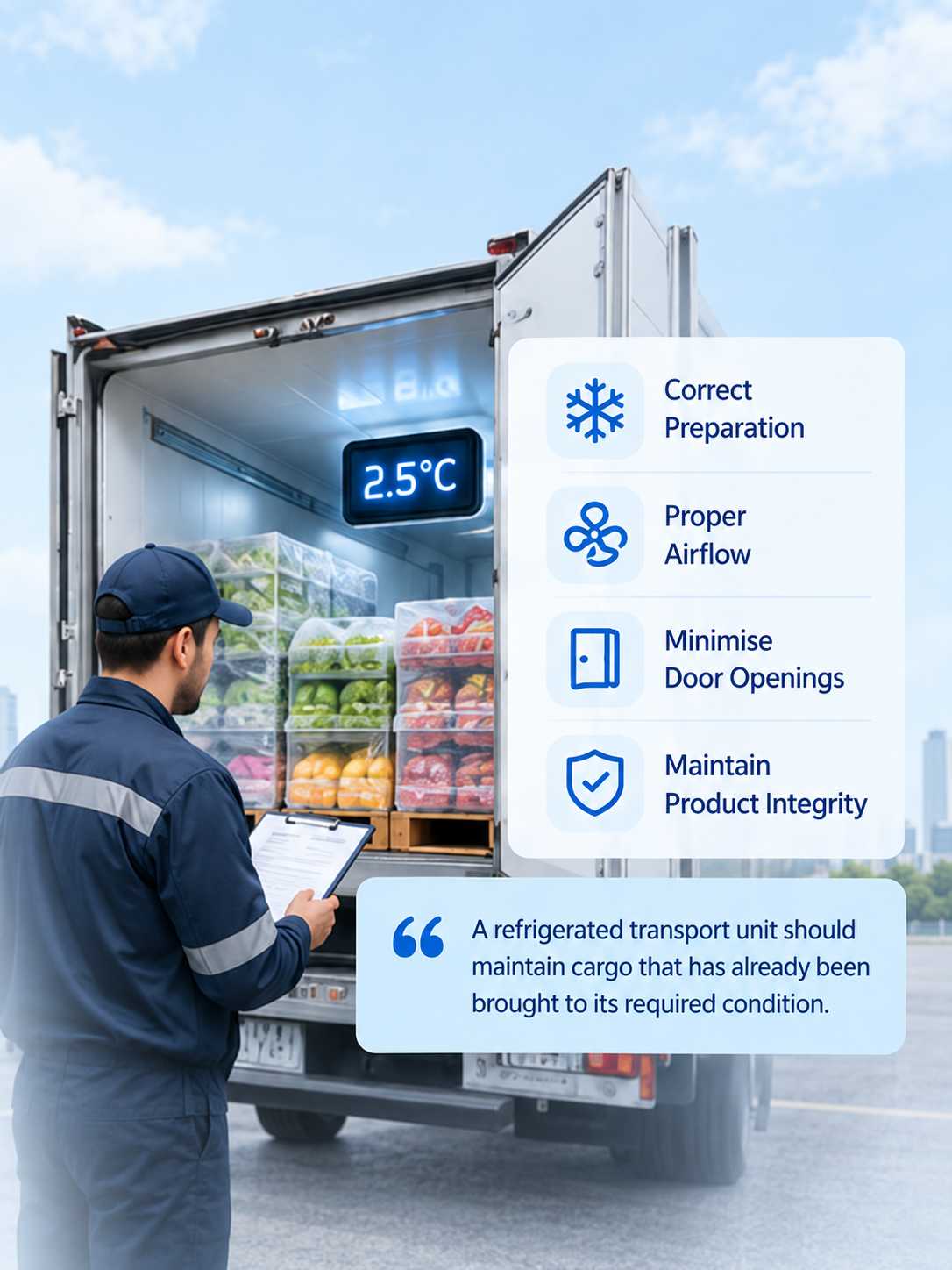
The first requirement is establishing the target transport temperature and making sure the allocated refrigerated compartment is suitable for the cargo before loading. Pre-cooling appropriate equipment reduces the heat already present in the cargo space, but it does not replace correct product preparation.

A refrigerated transport unit should normally maintain cargo that has already been brought to its required condition rather than being relied upon to rapidly cool warm stock. Airflow also matters. Filling the cargo box so tightly that refrigerated air cannot circulate can create uneven conditions even when the controller displays the expected set point. Door management is equally important. Every prolonged opening allows warm ambient air into the compartment. This becomes particularly relevant on multi-stop routes.

When assessing a temperature-controlled job, the information that matters includes:

Required cargo
temperature

Condition of the cargo
before loading

Load
configuration

Direct or multi-stop
route

Expected
door openings

Loading and
unloading time

Monitoring
requirements

Any customer-specific
transport procedure

Set Point ≠ Return-Air Temperature ≠ Product-Core Temperature

A controller reading tells you about the refrigeration environment; it does not by itself prove that every product at every point in the load is at exactly that temperature.

For sensitive cargo, loading condition, sensor location and temperature-record requirements should therefore be agreed before dispatch.

VISIBILITY AND VERIFICATION

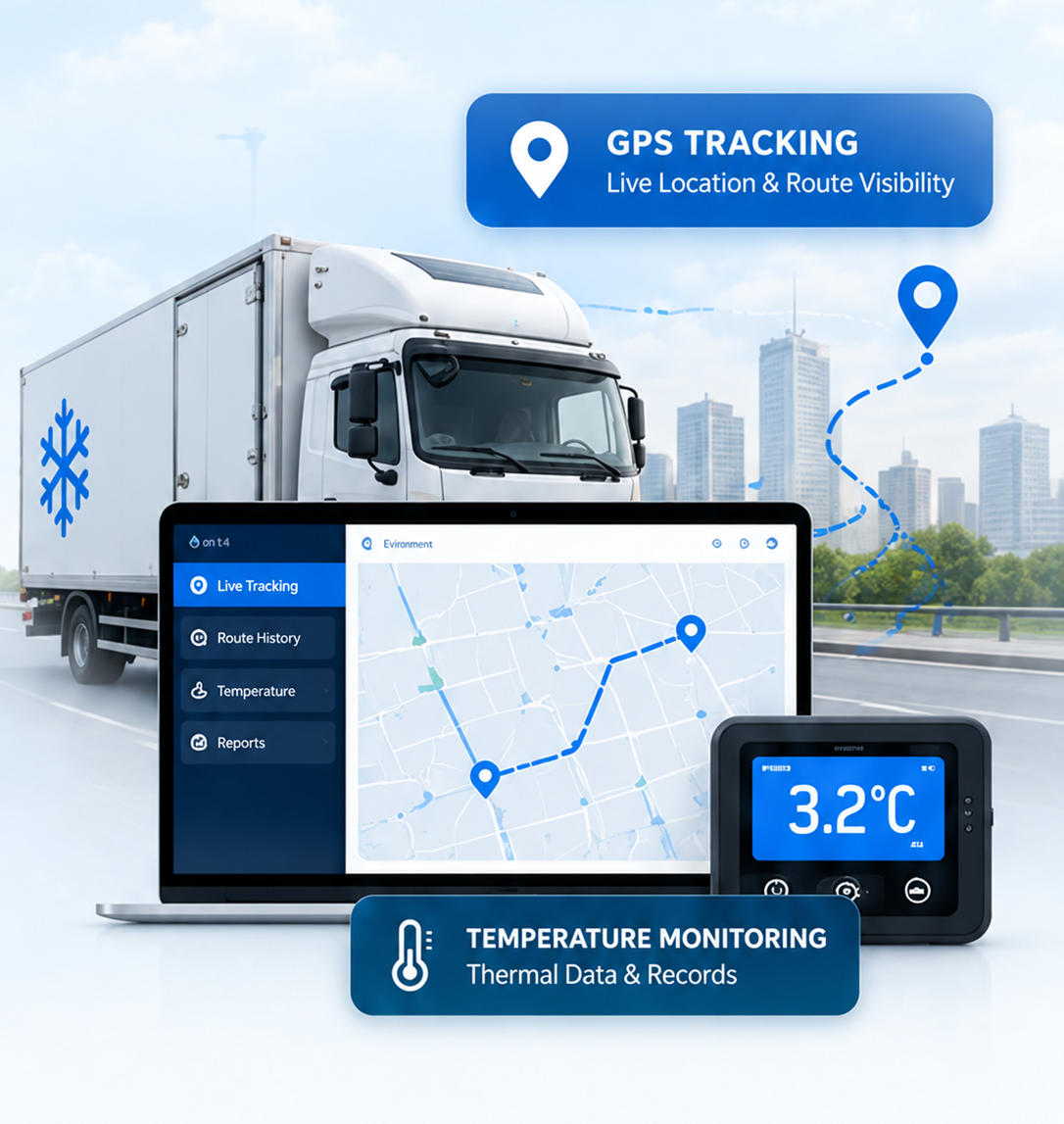
Temperature Monitoring, GPS Tracking & Delivery Records

GPS tracking proves where a truck is; temperature monitoring helps show what happened inside the refrigerated environment. They are not the same system.

Location data can support route visibility, dispatch coordination and estimated arrival times. Temperature data can support the review of thermal conditions during transport.

Monitoring requirements vary by cargo and customer procedure. Where documented evidence is required, confirm the availability and specification of the temperature-recording system before dispatch.

A customer with stricter quality procedures may require a:

Temperature
logger

Series of
recorded readings

Timestamped
temperature record

Alarm-event
record

Exportable
trip report

That requirement needs to be stated before booking. A data logger is more useful when the customer knows what evidence is required by its own quality system.

Product-Specific Requirements

For pharmaceutical or other controlled products, do not assume ordinary fleet telematics satisfy the customer’s documentation protocol. The shipper should provide the required transport specification.

Discuss Your Temperature-Controlled
Transport Requirements

Tell us about your cargo, required temperature, monitoring needs and delivery details, and we’ll advise on the most suitable option.

C O L D C H A I N B E S T P R A C T I C E

Cleaning, Sanitisation & Cargo Readiness for
Refrigerated Trucks

A refrigerated cargo body should be clean, maintained and suitable for the product before loading begins. This helps protect product quality, food safety and the integrity of your supply chain.

Can Look Clean But
Still Be Unsuitable
A cargo body may appear clean but still carry odours, residues or previous cargo traces that make it unsuitable for certain products.
Sanitisation
and Disinfection
The cargo body should be properly sanitised and disinfected to remove bacteria, odours and harmful residues.
Cargo
Compatibility
Ensure the vehicle is suitable for the specific product, including temperature range and any special handling needs.
Surface and
Seal Condition
Check interior surfaces, drainage, seals, doors and airflow systems are in good condition and free from damage or contamination.
Separation
Requirements
Some products require physical separation from others to prevent odour transfer, cross-contamination or quality issues.
Pre-loading
Inspection

Carry out a final inspection before loading to confirm cleanliness, temperature readiness and overall suitability.

If a customer requires a specific cleaning procedure, cargo-separation requirement or pre-loading inspection, it should be stated before vehicle allocation.
A W I D E R W O R L D I N C O N T R O L

What Can You Transport in a Refrigerated Truck?

Refrigerated trucks are used for products whose quality, safety, or commercial condition depends on controlled transport temperature.

Common Food Cargo
F R E S H E R P R O D U C T S . B R I G H T E R O P P O R T U N I T I E S .
Fresh fruits
and vegetables
Milk, cheese, yoghurt
and dairy products
Meat and poultry
Fish and seafood
Frozen meat
Ice cream
Frozen meals
Prepared foods
Restaurant and
catering ingredients
Desserts
Chilled beverages
Other Temperature-Controlled Products
Healthcare products
Medicines, vaccines,
clinical supplies
Floral products
Cut flowers and
other temperature-
sensitive blooms
Specialist ingredients
Fine foods, confectionery,
chocolate, bakery
ingredients and more
Important Considerations

• Different foods should not automatically share one vehicle compartment.
• Consider required temperature, packaging, hygiene risk, odour transfer and cross-contamination.
• Pharmaceutical cargo must be booked from product specification, not from a generic assumption.
• Unusual cargo should be verified before loading.

B U I L T F O R B U S I N E S S E S T H A T K E E P T H E W O R L D S U P P L I E D

Refrigerated Transport for Food, Hospitality, Retail & Distribution

Refrigerated truck rental is most useful to businesses that need controlled transport capacity without permanently expanding their own fleet.
Food Distributors & FMCG Operators

Move fresh, chilled and frozen products efficiently to keep shelves stocked and customers satisfied.

Restaurants, Hotels &
Cloud Kitchens
Maintain the quality and safety of ingredients across multiple outlets and delivery locations.
Meat, Poultry &
Seafood Suppliers
Reliable temperature-controlled transport for sensitive, high-value products.
Supermarkets & Grocery Operators
Support consistent supply from distribution centres to stores, with reliable cold-chain capacity.
Catering & Events
Transport ingredients and prepared foods safely for events, functions and large-scale catering operations.
Healthcare &
Pharmaceutical Cargo
Temperature-controlled transport for medicines, vaccines and other healthcare products.
R E A D Y T O M O V E Y O U R C A R G O ?

Tell us what you are moving

Send your cargo details, required condition and any special handling procedure to confirm the right refrigerated transport option for your needs.
O U R A D V A N T A G E

Why Choose Elite Chiller Transport

for Refrigerated Truck Rental?

Elite Chiller Transport matches the refrigerated vehicle to the cargo requirement instead of selecting a truck from size alone. Before recommending a vehicle, we ask for the cargo type, required transport temperature, approximate weight or volume, pickup location, destination, number of stops and rental period. These details help determine whether the job requires chilled or frozen transport and whether a 3-ton, 7-ton or 10-ton refrigerated truck is the more suitable class.
01
RIGHT CARGO RIGHT TRUCK

Truck Selection Starts
With the Actual Load

A refrigerated truck is selected from more than its advertised tonnage. We consider the product, required temperature, load size, pickup and delivery locations, number of stops, loading requirements, rental duration and more.

Cargo type & temperature
Load size & weight
Pickup & delivery locations
Stops, loading needs & rental duration
02
DIFFERENT CARGO DIFFERENT CARE

Chilled and Frozen Transport
Are Treated as Different
Requirements

We do not treat every temperature-controlled delivery as the same type of job. A request for +4°C chilled transport is different from a requirement to maintain −18°C frozen cargo.
Chilled: around +4°C
Frozen: around −18°C
Vehicle and setup matched to cargo
Proper temperature maintenance
03
RIGHT CARGO RIGHT TRUCK

3-Ton, 7-Ton & 10-Ton
Refrigerated Truck Options

Our options include 3-ton, 7-ton and 10-ton commercial truck classes, subject to availability. The truck class is selected after considering cargo weight, usable volume, refrigeration requirement, route access and loading method.
3-ton for smaller, flexible loads
7-ton for medium volume
10-ton for larger requirements
Selected based on your cargo & route
04
EVERY ROUTE
IS UNIQUE

Route Requirements Are
Considered Before Quotation

A direct delivery is different from a multi-stop route. We consider pickup location, destination, number of stops, waiting time and any fixed loading or delivery windows, especially in Abu Dhabi, Dubai, Mussafah, Al Ain and Dubai.
Single or multi-stop routes
City access and delivery windows
Waiting time and on-site requirements
Route assessed before we quote
05
FLEXIBLE TERMS FOR YOUR BUSINESS

Daily, Weekly & Monthly
Requirements Are Assessed
Differently

We handle one-day deliveries to recurring transport arrangements. A one-day requirement may involve a single delivery or event, while weekly and monthly arrangements require more details about kilometres, operating days and driver requirements.
One-day, weekly or monthly
Distance and operating days
Driver requirements if needed
Plan matched to your operations
06
SAME STANDARDS EVEN WHEN URGENT

Urgent Requests Still Start
With the Cargo Requirement

For urgent and same-day enquiries, availability matters—but suitability comes first. We still need the essential information: cargo + required temperature + load size + pickup + destination + required time.
Check availability for urgent requests
Cargo details still required
Temperature, load size, pickup & destination
Aim for the right truck, not just a fast one
MORE THAN JUST A TRUCK
A PARTNER FOR YOUR COLD CHAIN
Right Truck
for Your Cargo
Temperature-Focused
Solutions
Reliable & Professional
Support
Serving Across
the UAE

Refrigerated Truck Rental UAE FAQs

Refrigerated truck rental is the temporary hire of a commercial vehicle with an insulated, mechanically cooled cargo compartment for transporting chilled, frozen or other temperature-sensitive goods.
It sits within the broader categories of commercial vehicle rental, refrigerated transport and temperature-controlled logistics.
A refrigerated truck is commonly called a reefer truck.
“Chiller truck” usually describes chilled transport, while “freezer truck” identifies a vehicle used for frozen cargo. The required temperature should always be confirmed regardless of the term used.
Choose the truck from cargo weight, volume, pallet dimensions, temperature requirement and route—not from weight alone.
A 3-ton class may suit moderate commercial loads, while 7-ton or 10-ton classes may suit larger distribution requirements.
Actual payload must be confirmed for the allocated vehicle.
Do not rely on a transport refrigeration unit to rapidly cool warm cargo.
Cold-chain transport normally works best when products are already at their required condition and the prepared truck maintains that condition during transportation.
The set point should follow the cargo specification.
Many chilled food operations work around 5°C or below and frozen food around −18°C, but the correct target depends on the product and applicable requirement.
Pharmaceutical products can have entirely different validated ranges.
No. A chiller truck maintains cooled cargo, while a freezer truck is configured for sub-zero frozen transport.
Both fall within the wider refrigerated or temperature-controlled truck category.
Yes, short-term demand can be handled through daily rental where the required vehicle is available.
One-day hire can be relevant to events, emergency replacement, temporary delivery demand and one-off distribution work.
Monthly rental is suitable for businesses with recurring transport requirements and should be quoted from expected use rather than daily price alone.
Route frequency, kilometres, driver allocation, vehicle class and operating hours can change the commercial arrangement.
Driver-included refrigerated transport can be arranged according to vehicle and route availability.
Provide the loading time, delivery point, expected operating hours and number of stops when requesting the quotation.
GPS and temperature monitoring are separate capabilities and should be confirmed for the allocated vehicle.
If your quality system requires downloadable temperature records or a data logger, state that before booking rather than assuming ordinary GPS tracking provides temperature evidence.
Suitable pharmaceutical cargo can only be accepted where the vehicle and operating process meet the product’s documented transport requirements.
Do not assume every pharmaceutical requires +2°C to +8°C or that every refrigerated truck is qualified for pharmaceutical distribution.
Same-day dispatch depends on the required truck class, temperature mode, driver, location and fleet availability.
Send the cargo, temperature, load, pickup, destination and required time together for the fastest assessment.
Vehicle capacity, refrigeration requirement, rental duration, route, kilometres, driver, waiting time and special equipment can all change the rental price.
An exact quote based on the actual job is more useful than an advertised rate that excludes important operating conditions.

READY TO MOVE YOUR CARGO? ─────

Book a Refrigerated
Truck in the UAE

Send us your cargo type, required temperature, load size, pickup, destination, date and rental period to request the right refrigerated truck and an accurate quotation.

Whether you need a 3-ton refrigerated truck for a local chilled delivery, a larger truck for recurring food distribution, a freezer truck for frozen cargo or monthly temperature-controlled transport, the booking starts with the same question: What does your cargo actually require?

Request refrigerated truck availability and pricing.

Reliable
Fleet
Temperature
Control
UAE Wide
Coverage
Supporting
Your Business

Send the following details in one message:

With this information, we can assess the vehicle class, refrigeration requirement and rental arrangement against the actual job.

Call Now Button