Refrigerated Truck Rental UAE for Temperature-Controlled Transport
Elite Chiller Transport provides refrigerated truck rental across the UAE for food, hospitality, retail and distribution businesses. We match the right truck to your cargo type, temperature requirement, load size, route and rental period.
Chilled, frozen or temperature-sensitive cargo — tell us what you need to move, where it’s going and for how long, and we’ll help you choose the right refrigerated truck.
HACCP Certified
ASATEEL Registered
Temperature
Monitored
Transport
24/7 Support
Refrigerated Truck Rental for
Chilled, Frozen & Temperature-
Sensitive Cargo
The important word is not simply “truck.”
It is controlled.
It’s not just about moving cargo.
It’s about maintaining the right
temperature from start to finish.
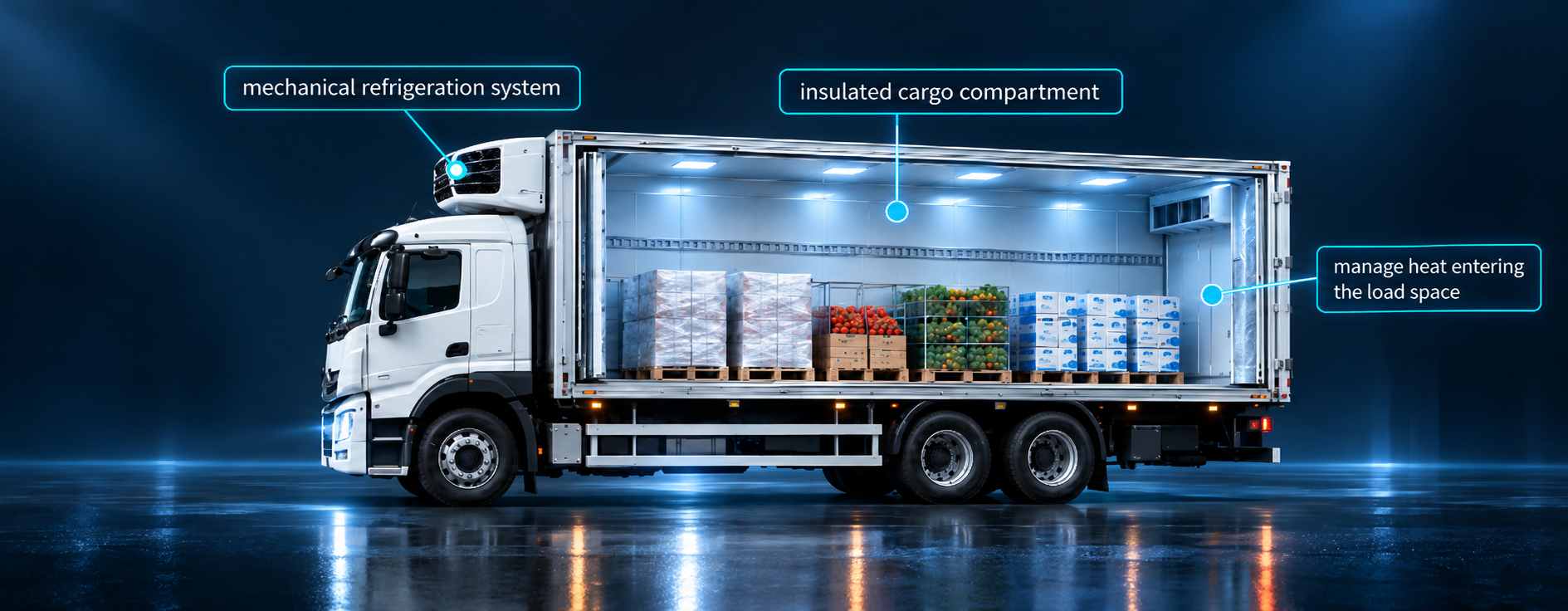
Refrigerated truck rental gives a business temporary access to a temperature-controlled commercial vehicle without purchasing and maintaining its own refrigerated fleet.
It helps you move chilled, frozen and other temperature-sensitive goods safely, reliably and in full control.
Chiller Truck
Configured to maintain the conditions required for cooled products during transport.
Freezer Truck
Configured to maintain frozen cargo conditions throughout the journey.
Refrigerated Truck
Controlled-Temperature
Distribution
The broader commercial vehicle category used for controlled-temperature transport.
door openings
delivery points
Which Refrigerated Truck Do You Need for
Your Cargo?
Choose the truck from the cargo requirement first, then choose the vehicle size. Starting with “I need a 3-ton truck” can produce the wrong booking. A more useful specification starts with the product, target temperature, load dimensions, weight, number of delivery stops and unloading method.
Key Questions Before Booking
Dairy, frozen meat, seafood, produce, prepared food and other products can have different handling requirements.
is there?
or loose cargo?
records required?
Our Refrigerated Truck Fleet, Sizes & Specifications
- Actual payload
- Internal dimensions
- Required temperature
- Loading method
- Cargo weight
- Pallet arrangement
- Access restrictions
- Unloading requirements
- Legal payload
- Route access
- Delivery slot
- Cargo configuration and equipment requirements
Additional Considerations
Refrigerated Truck Rental
Prices in the UAE
Before Accepting a Price,
Check the Following:
class
duration
(where applicable)
arrangement
arrangement
time
requirement
of stops
or equipment
requirements
The Cheapest Quote Is Not Always the Lowest-Cost Option
Daily, Weekly or Monthly Refrigerated Truck Rental?
Refrigerated trucks can be hired around the duration of the transport requirement rather than forcing every customer into the same contract model.
Daily Rental
A daily refrigerated truck rental is appropriate when the requirement is temporary: an event, urgent delivery, replacement vehicle, unexpected increase in orders or one-off warehouse movement.
Weekly Rental
A weekly arrangement can make more operational sense when deliveries continue across several days but do not justify a long fleet commitment.
Monthly Rental
A monthly refrigerated truck rental is usually relevant to distributors, food suppliers, hospitality operators and other businesses that need recurring temperature-controlled capacity.
Compare the actual operating requirement.
Daily, weekly and monthly arrangements serve different operating requirements, so the most suitable option depends on how frequently and intensively the vehicle will be used.
Compare These Before Choosing a Rental Period
For recurring routes, give us a typical weekly schedule. It produces a more useful assessment than requesting “monthly price” without the operating pattern.
What Temperature Does Your Cargo Need During Transport?
The correct transport temperature is the temperature required by the product—not a universal setting used for every refrigerated load.
“Refrigerated,” “chilled” and “frozen” describe different thermal requirements. Setting a truck colder than necessary can be as problematic for some products as running it too warm.
Cargo condition
Useful operating reference
Important qualification
Chilled food
Common food-safety frameworks use approximately ≤5°C for cold holding
Follow the product specification and applicable local requirement
Frozen food
−18°C is a widely used frozen-food reference
Product must already be appropriately frozen before transport
Vaccines / medicines
Many vaccines use +2°C to +8°C
This range does not apply to every pharmaceutical product
Other temperature-sensitive products
Product-specific
Follow manufacturer, shipper or validated transport requirements
Codex guidance emphasizes maintaining the required product conditions through storage and transport, while WHO notes that many vaccines use the traditional +2°C to +8°C cold chain. WHO also documents other validated temperature conditions for particular vaccines, which is why “all medicine goes at 2–8°C” is not a safe assumption.
Frozen is not simply “extra chilled.”
It is a different product state with a different control requirement.
When booking, give the required temperature as a number whenever possible.
For example:
That information is more useful than writing only “cold truck required.”
Chiller Truck vs Freezer Truck vs Reefer Truck: Which Do You Need?
Use a chiller truck for cargo that must remain cooled above freezing, a freezer truck for products that must remain frozen, and “reefer truck” as the broader refrigerated-vehicle term used across temperature-controlled transport.
Chiller Truck
Cooled above freezing.
A chiller truck is normally selected for products such as dairy, chilled beverages, fresh ingredients and other goods that need cooling without freezing.
Freezer Truck
Sub-zero transport.
A freezer truck serves frozen products such as frozen meat, seafood, ice cream and frozen foods where sub-zero conditions must be maintained.
Reefer Truck
Broad industry term.
A reefer truck is industry language for a refrigerated vehicle equipped with a refrigeration system.
1. Required temperature
e.g. +4°C, −18°C
2. Cargo type / product state
e.g. chilled, frozen, vaccines
3. Vehicle type
e.g. chiller, freezer or reefer truck
In practice, people sometimes use “reefer,” “refrigerated truck,” “chiller truck” and “freezer truck” interchangeably, but the operational requirement should still be defined by the actual temperature needed.
If you are unsure which one to request, send the product and required storage or transport temperature. That information is more useful than trying to choose the terminology yourself.
Refrigerated Truck Rental With a Driver or Specific Driver Requirements
Driver requirements should be confirmed before quotation because refrigerated transport involves both vehicle operation and refrigeration-system handling.
Driver-included booking
Let us handle the driving, so you can focus on your cargo.
A driver supplied for a temperature-controlled route needs to understand more than navigation. The job can involve checking the refrigeration controller, protecting the cargo compartment during stops, managing doors correctly, following delivery windows and reporting operational problems.
- Controller checks – check the refrigeration controller and settings as required.
- Cargo protection during stops – take reasonable measures to keep cargo safe.
- Door management – proper door operation to help maintain temperature.
- Delivery windows – follow agreed delivery schedule.
- Reporting issues – notify operational or temperature problems.
Self-drive refrigerated truck
Request self-drive availability at the beginning of the enquiry.
If you specifically require a self-drive refrigerated truck, state that at the beginning of the enquiry so availability, vehicle class, insurance, licensing and rental-policy requirements can be checked.
Do not assume every commercial refrigerated vehicle can be released without a driver.
For scheduled commercial distribution, a vehicle-with-driver arrangement can remove the need for the customer to organise an eligible commercial driver separately.
For driver-included bookings, provide:
Loading time
Destination
Expected waiting time
Number of stops
Route or delivery details
Choose the right vehicle and rental arrangement.
Tell us about your cargo, temperature and delivery plans, and we’ll help you find the best solution.
What We Confirm for
Temperature-Controlled Transport
Temperature control starts before the truck moves.
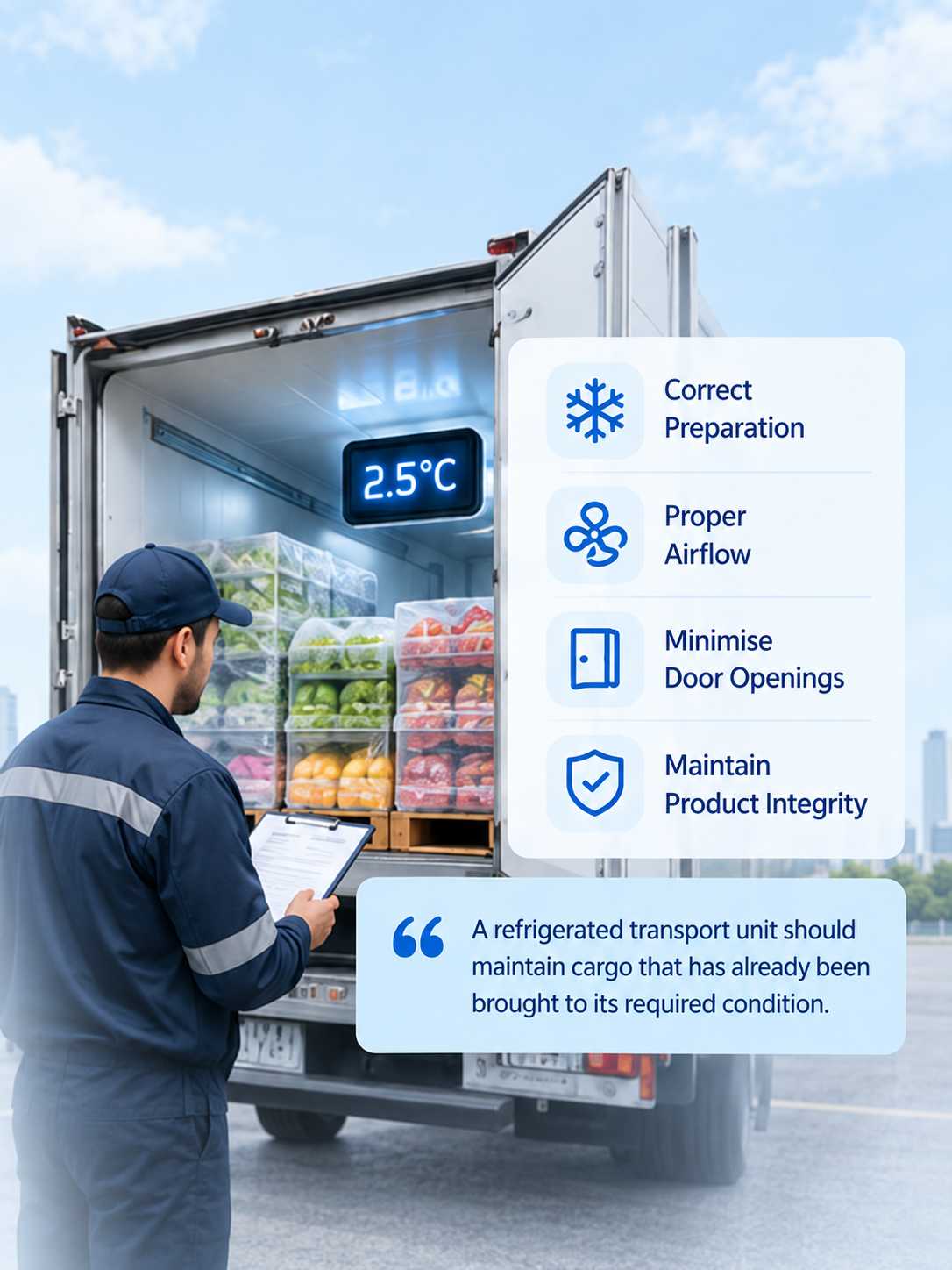
The first requirement is establishing the target transport temperature and making sure the allocated refrigerated compartment is suitable for the cargo before loading. Pre-cooling appropriate equipment reduces the heat already present in the cargo space, but it does not replace correct product preparation.
A refrigerated transport unit should normally maintain cargo that has already been brought to its required condition rather than being relied upon to rapidly cool warm stock. Airflow also matters. Filling the cargo box so tightly that refrigerated air cannot circulate can create uneven conditions even when the controller displays the expected set point. Door management is equally important. Every prolonged opening allows warm ambient air into the compartment. This becomes particularly relevant on multi-stop routes.
When assessing a temperature-controlled job, the information that matters includes:
Required cargo
temperature
Condition of the cargo
before loading
Load
configuration
Direct or multi-stop
route
Expected
door openings
Loading and
unloading time
Monitoring
requirements
Any customer-specific
transport procedure
Set Point ≠ Return-Air Temperature ≠ Product-Core Temperature
A controller reading tells you about the refrigeration environment; it does not by itself prove that every product at every point in the load is at exactly that temperature.
For sensitive cargo, loading condition, sensor location and temperature-record requirements should therefore be agreed before dispatch.
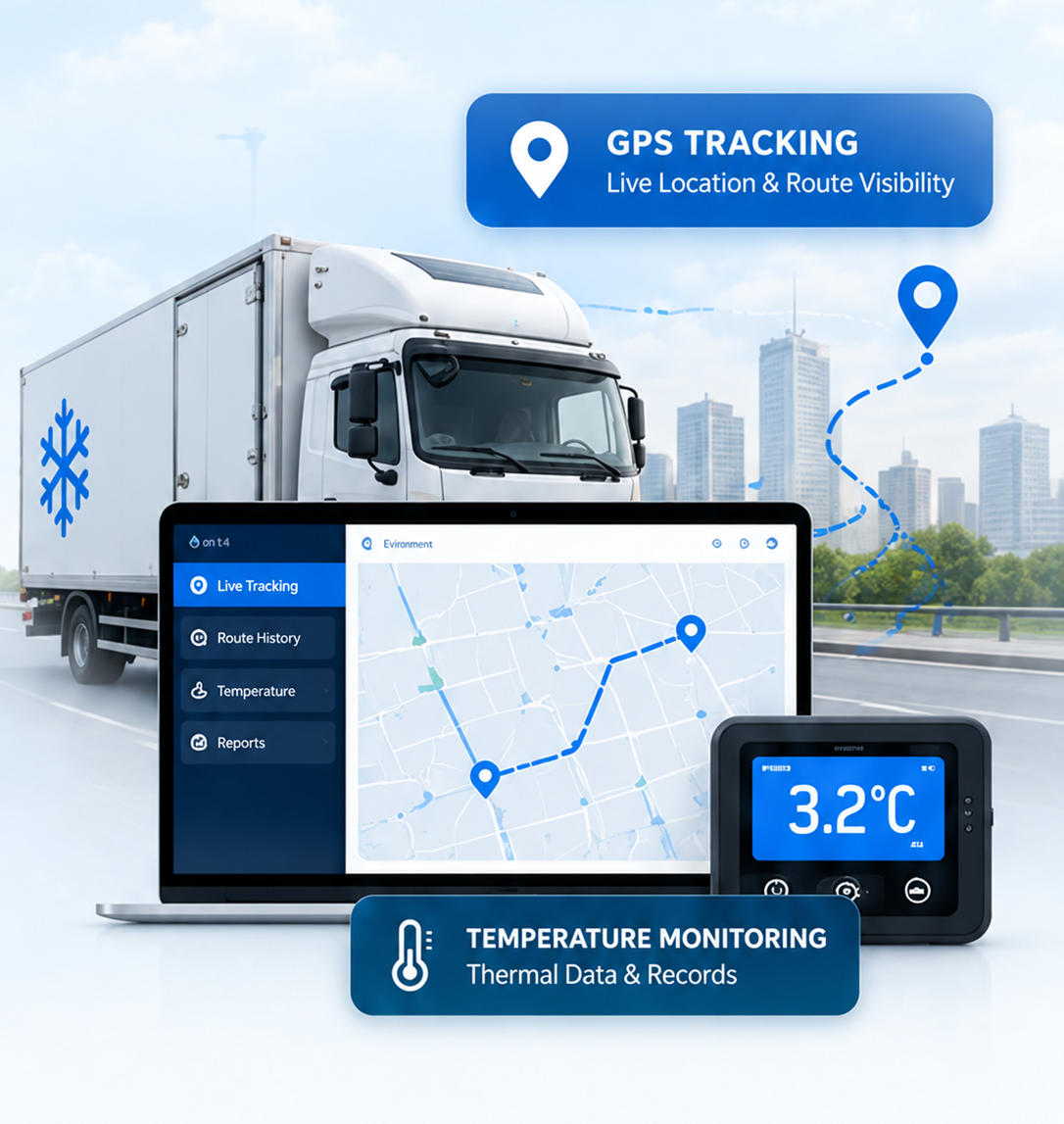
Temperature Monitoring, GPS Tracking & Delivery Records
GPS tracking proves where a truck is; temperature monitoring helps show what happened inside the refrigerated environment. They are not the same system.
Location data can support route visibility, dispatch coordination and estimated arrival times. Temperature data can support the review of thermal conditions during transport.
Monitoring requirements vary by cargo and customer procedure. Where documented evidence is required, confirm the availability and specification of the temperature-recording system before dispatch.
A customer with stricter quality procedures may require a:
Temperature
logger
Series of
recorded readings
Timestamped
temperature record
Alarm-event
record
Exportable
trip report
That requirement needs to be stated before booking. A data logger is more useful when the customer knows what evidence is required by its own quality system.
Product-Specific Requirements
For pharmaceutical or other controlled products, do not assume ordinary fleet telematics satisfy the customer’s documentation protocol. The shipper should provide the required transport specification.
Discuss Your Temperature-Controlled
Transport Requirements
Tell us about your cargo, required temperature, monitoring needs and delivery details, and we’ll advise on the most suitable option.
Cleaning, Sanitisation & Cargo Readiness for
Refrigerated Trucks
A refrigerated cargo body should be clean, maintained and suitable for the product before loading begins. This helps protect product quality, food safety and the integrity of your supply chain.
Still Be Unsuitable
and Disinfection
Compatibility
Seal Condition
Requirements
Inspection
Carry out a final inspection before loading to confirm cleanliness, temperature readiness and overall suitability.
What Can You Transport in a Refrigerated Truck?
Refrigerated trucks are used for products whose quality, safety, or commercial condition depends on controlled transport temperature.
and vegetables
and dairy products
catering ingredients
clinical supplies
other temperature-
sensitive blooms
chocolate, bakery
ingredients and more
• Different foods should not automatically share one vehicle compartment.
• Consider required temperature, packaging, hygiene risk, odour transfer and cross-contamination.
• Pharmaceutical cargo must be booked from product specification, not from a generic assumption.
• Unusual cargo should be verified before loading.
Refrigerated Transport for Food, Hospitality, Retail & Distribution
Move fresh, chilled and frozen products efficiently to keep shelves stocked and customers satisfied.
Cloud Kitchens
Seafood Suppliers
Pharmaceutical Cargo
Tell us what you are moving
Why Choose Elite Chiller Transport
for Refrigerated Truck Rental?
Truck Selection Starts
With the Actual Load
A refrigerated truck is selected from more than its advertised tonnage. We consider the product, required temperature, load size, pickup and delivery locations, number of stops, loading requirements, rental duration and more.
Chilled and Frozen Transport
Are Treated as Different
Requirements
3-Ton, 7-Ton & 10-Ton
Refrigerated Truck Options
IS UNIQUE
Route Requirements Are
Considered Before Quotation
Daily, Weekly & Monthly
Requirements Are Assessed
Differently
Urgent Requests Still Start
With the Cargo Requirement
A PARTNER FOR YOUR COLD CHAIN
for Your Cargo
Solutions
Support
the UAE
Refrigerated Truck Rental UAE FAQs
It sits within the broader categories of commercial vehicle rental, refrigerated transport and temperature-controlled logistics.
“Chiller truck” usually describes chilled transport, while “freezer truck” identifies a vehicle used for frozen cargo. The required temperature should always be confirmed regardless of the term used.
A 3-ton class may suit moderate commercial loads, while 7-ton or 10-ton classes may suit larger distribution requirements.
Actual payload must be confirmed for the allocated vehicle.
Cold-chain transport normally works best when products are already at their required condition and the prepared truck maintains that condition during transportation.
Many chilled food operations work around 5°C or below and frozen food around −18°C, but the correct target depends on the product and applicable requirement.
Pharmaceutical products can have entirely different validated ranges.
Both fall within the wider refrigerated or temperature-controlled truck category.
One-day hire can be relevant to events, emergency replacement, temporary delivery demand and one-off distribution work.
Route frequency, kilometres, driver allocation, vehicle class and operating hours can change the commercial arrangement.
Provide the loading time, delivery point, expected operating hours and number of stops when requesting the quotation.
If your quality system requires downloadable temperature records or a data logger, state that before booking rather than assuming ordinary GPS tracking provides temperature evidence.
Do not assume every pharmaceutical requires +2°C to +8°C or that every refrigerated truck is qualified for pharmaceutical distribution.
Send the cargo, temperature, load, pickup, destination and required time together for the fastest assessment.
An exact quote based on the actual job is more useful than an advertised rate that excludes important operating conditions.

Book a Refrigerated
Truck in the UAE
Send us your cargo type, required temperature, load size, pickup, destination, date and rental period to request the right refrigerated truck and an accurate quotation.
Whether you need a 3-ton refrigerated truck for a local chilled delivery, a larger truck for recurring food distribution, a freezer truck for frozen cargo or monthly temperature-controlled transport, the booking starts with the same question: What does your cargo actually require?
Request refrigerated truck availability and pricing.
Fleet
Control
Coverage
Your Business
Send the following details in one message:
- Cargo type
- Temperature
- Load
- Pickup
- Destination
- Stops
- Date
- Rental period
- Additional requirements
With this information, we can assess the vehicle class, refrigeration requirement and rental arrangement against the actual job.